Choosing between t-shirts vs sweatshirts for a custom design comes down to more than personal preference. Fabric weight, printing method, climate, and how the finished garment will actually be worn all shape which base garment gives a design the best chance of looking sharp and lasting through repeated washing.
This guide breaks down t-shirts vs sweatshirts across fabric, print durability, cost, and use case, so buyers and brands can pick the right base garment before committing to a design or a bulk order. We also cover how LAMBLILY, a kidswear manufacturer based in Chennai, approaches custom printing across both garment types.

Why the T-Shirts vs Sweatshirts Decision Matters
A design that looks great on a lightweight cotton tee will not automatically translate well onto a heavier fleece sweatshirt, and the reverse is just as true. The t-shirts vs sweatshirts decision affects everything downstream, from which printing method suits the fabric to how the finished garment fits into a buyer's seasonal collection plan.
- Fabric weight changes how a print sits on the surface and how it wears over time.
- Printing method choice often differs between a thin knit tee and a heavier fleece sweatshirt.
- Season and climate shape which garment a customer will actually reach for and wear.
- Production cost and minimum order quantity can differ meaningfully between the two categories.
Our team walks buyers through these factors early in a project, since choosing the wrong base garment for a design tends to surface as a complaint only after a bulk order has already shipped.
Fabric Differences Between T-Shirts and Sweatshirts
The most fundamental difference in t-shirts vs sweatshirts is fabric weight and construction, which drives nearly every other decision that follows.
- T-shirt fabric: typically single jersey cotton or cotton-blend knit, in the 140 to 180 GSM range, lightweight and breathable.
- Sweatshirt fabric: typically French terry or brushed fleece cotton, in the 260 to 380 GSM range, heavier and warmer.
- T-shirt construction: simple single-layer knit, with minimal seams and a close-to-body drape.
- Sweatshirt construction: often a looped or brushed inner face for warmth, with ribbed cuffs and hem for structure.
Buyers choosing between t-shirts vs sweatshirts for a design should start with fabric weight, since it determines both how the print will sit on the surface and how the finished garment will actually be worn across a season.
Printing Method Suitability for Each Garment
Printing method choice shifts depending on which side of the t-shirts vs sweatshirts decision a buyer lands on, since fabric surface and weight interact differently with each method.
- Screen printing: works well on both t-shirts and sweatshirts, cost-effective for larger orders with limited colors.
- DTF (direct-to-film) printing: holds fine detail on lightweight cotton tees and on brushed fleece sweatshirts alike.
- DTG (direct-to-garment) printing: better suited to detailed, multi-color designs on flatter t-shirt fabric.
- Puff print: adds texture that reads especially well on heavier sweatshirt fabric.
- Embroidery: works on both, though it suits smaller logo placements better than full-front designs on either garment.
Our detailed comparison in the art of custom printing covers placement and printing method decisions in more depth, applicable to both t-shirts vs sweatshirts comparisons.
Comparing T-Shirts and Sweatshirts Side by Side
The table below summarizes the core differences buyers should weigh when deciding between t-shirts vs sweatshirts for a custom design project.
| Factor | T-Shirts | Sweatshirts |
|---|---|---|
| Typical GSM | 140-180 | 260-380 |
| Best season | Warm weather, year-round basics | Cooler weather, layering |
| Best printing methods | Screen print, DTG, DTF | Screen print, DTF, puff print |
| Typical MOQ | 100 pieces per colour | 300 pieces per style |
| Cost per unit | Lower | Higher |
When a T-Shirt Is the Better Choice
Certain use cases consistently favor a t-shirt over a sweatshirt within the t-shirts vs sweatshirts decision. Our team recommends a t-shirt base when the priority is year-round wearability and lower per-unit cost.
- Warm-climate markets, where a heavier sweatshirt would rarely get worn.
- Large-volume retail programs, where lower per-unit cost matters more than premium positioning.
- Everyday basics collections, where versatility across seasons matters more than a statement piece.
- Designs with fine detail or many colors, which read more clearly on flatter t-shirt fabric.
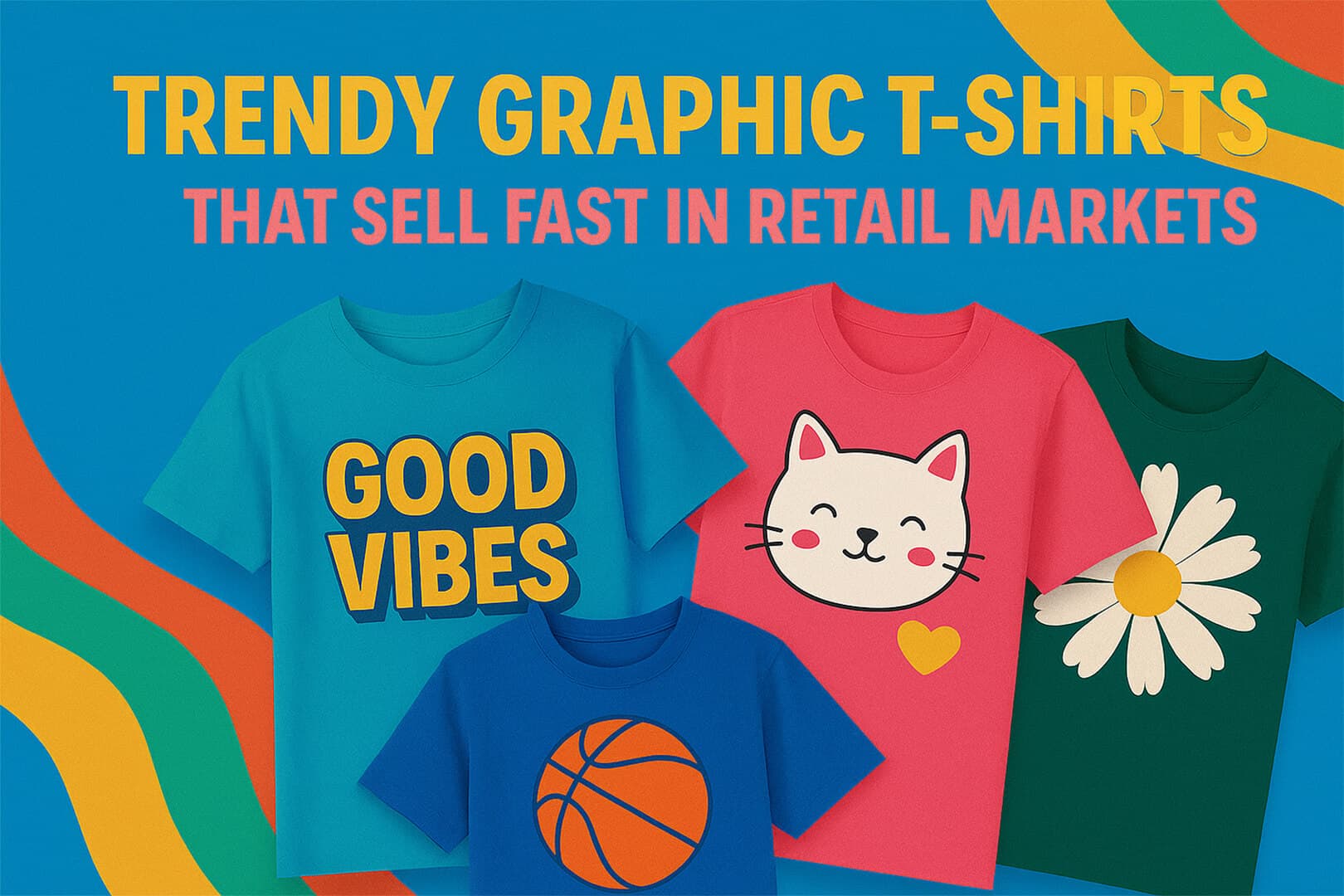
For buyers focused specifically on graphic tee programs, our guide on trendy graphic t-shirts for retail markets covers fabric and design trends in more depth.
When a Sweatshirt Is the Better Choice
The opposite set of conditions tends to favor a sweatshirt within the t-shirts vs sweatshirts comparison, particularly where warmth, premium positioning, or bold branding matter more than unit cost.
- Cooler-climate markets, or collections designed for layering during transitional weather.
- Premium or streetwear-positioned brands, where a heavier garment supports a higher price point.
- Designs that benefit from puff print or embroidery texture, which reads better on heavier fleece.
- School and institutional programs, where a sweatshirt often anchors a winter uniform range.
Our guide on customized sweatshirts for your brand covers fit, fabric, and minimum order quantity for sweatshirt-specific programs in more detail.
Durability and Print Longevity Compared
Print durability differs between t-shirts vs sweatshirts partly because of fabric weight and partly because of how each garment gets worn and washed. Lighter t-shirt fabric can show print wear faster under frequent stretching, while heavier sweatshirt fabric holds a print's shape a little longer but is often washed less frequently, which can offset the difference.
Our team wash-tests every printed sample before bulk production, regardless of which garment type is involved, since the same fabric and printing method combination can behave differently at 160 GSM versus 320 GSM. This step matters equally whether the decision lands on a t-shirt or a sweatshirt.
Cost and Minimum Order Quantity Differences
Cost is often the deciding factor once fabric and print quality are equal in a buyer's mind within the t-shirts vs sweatshirts decision. T-shirts generally cost less per unit and carry a lower minimum order quantity, starting at 100 pieces per colour in our production setup. Sweatshirts, given their heavier fabric and additional construction like ribbed cuffs and hems, generally cost more per unit, with a minimum order quantity starting at 300 pieces per style.
- Buyers testing a new design with a smaller budget often start with t-shirts before expanding into sweatshirts.
- Buyers building a premium or winter-focused line often accept the higher sweatshirt MOQ as part of the positioning.
- Mixed collections combining both garment types let a buyer balance unit cost against seasonal range.
How LAMBLILY Supports Both Garment Types
LAMBLILY PRIVATE LIMITED is based in Vandalur, Chennai, Tamil Nadu. It was founded in 2019 by Juliet Preena, a Montessori educator who leads design, and Leo Daniel Raja, who brings over 13 years of supply chain and manufacturing experience. Our team supports both sides of the t-shirts vs sweatshirts decision with the same certification and quality standards.
We manufacture on GOTS-certified organic cotton and OEKO-TEX-compliant fabric, with orders shipping FOB to the UAE, UK, USA, Canada, and Australia. Payment is handled through 100% advance SWIFT transfer, and minimum order quantity depends on which garment type a buyer chooses.
- T-shirts: MOQ from 100 pieces per colour, ideal for testing a new design before scaling up.
- Sweatshirts: MOQ from 300 pieces per style, splittable across sizes and up to three colors.
- Certified fabric: GOTS-certified organic cotton and OEKO-TEX Standard 100 compliance across both.
- Custom printing: DTF, sublimation, screen printing, and embroidery available for either garment.
- Private labeling: tags, labels, and packaging built to a buyer's brand specification.

A Decision Framework for Your Next Custom Design
When a buyer cannot immediately decide between t-shirts vs sweatshirts, our team walks through a short set of questions that usually clarifies the right choice.
- What climate will this garment primarily be worn in.
- Is the design detailed and multi-color, or bold and simple.
- Does the collection need to hit a lower price point, or support premium positioning.
- Will the finished garment be layered, or worn as a standalone piece.
- What minimum order quantity fits the buyer's current budget and testing stage.
Answering these questions honestly, before finalizing artwork, saves a buyer from discovering a mismatch between design and garment only after a bulk order has shipped.
Common Mistakes When Choosing Between the Two
Buyers weighing t-shirts vs sweatshirts sometimes make avoidable mistakes that surface only once a bulk order is already in production. Our team sees a handful of these repeat across new buyer relationships.
- Choosing a sweatshirt for a warm-climate market where a heavier garment rarely gets worn.
- Applying a highly detailed, multi-color design to heavy fleece where fine detail loses clarity.
- Underestimating the higher MOQ and per-unit cost that sweatshirts typically carry.
- Skipping a wash-tested sample because the design already worked well on the other garment type.
- Assuming print placement rules are identical across both garments without adjusting for fabric drape.
Catching these mismatches at the sampling stage, before bulk cutting begins, protects both budget and design quality.
How This Connects to Fabric and Sizing Decisions
Choosing between t-shirts vs sweatshirts connects directly to broader fabric and sizing decisions across a kidswear collection. Our guide on fabric for export t-shirts covers fabric evaluation in more depth, while our overview of French terry fabric for children's sweatshirts explains the specific fabric most commonly used across our sweatshirt range.
Buyers building a base t-shirt collection alongside a sweatshirt line often also review our round neck t-shirt guide, since round neck remains the most common t-shirt silhouette for custom printing programs.
Seasonal Collection Planning Across Both Garments
Many buyers do not actually need to choose exclusively between t-shirts vs sweatshirts, since a well-planned seasonal collection often includes both, sized to match how a customer's wardrobe shifts across the year. Our team frequently works with buyers building a combined range rather than a single-garment collection.
- Spring and summer drops typically lean heavily toward t-shirts, with sweatshirts held back for early and late-season transition pieces.
- Autumn and winter drops typically lean toward sweatshirts, with t-shirts continuing as base layers underneath.
- A shared design language across both garment types, using the same core artwork adapted for each fabric, keeps a collection visually cohesive.
- Ordering both garment types from the same factory keeps color matching and quality consistent across the full collection.
Planning this way also smooths out production scheduling, since a factory can stagger t-shirt and sweatshirt runs rather than compressing both into the same tight window ahead of a single seasonal launch. Our team typically recommends locking t-shirt artwork and fabric a few weeks ahead of sweatshirt artwork, purely to spread cutting and stitching capacity evenly across the two garment types rather than creating a bottleneck at a single point in the calendar. This staggered approach to t-shirts vs sweatshirts production has held up well across multiple seasonal cycles for our repeat buyers.
How Buyer Feedback Shapes the Final Choice
Our team rarely makes a final t-shirts vs sweatshirts recommendation without first understanding how a buyer's own customers have responded to past collections. Sell-through data, return rates, and even casual customer feedback often reveal preferences that a pure fabric-and-cost comparison would miss.
- A retailer whose t-shirt line consistently outsells outerwear may still find that a lightweight sweatshirt performs well as a transitional piece between seasons, rather than assuming the entire category should be dropped from the catalogue.
- A buyer whose customers frequently mention wanting warmer options may be underserving demand with a t-shirt-only catalogue.
- Return rate data tied to sizing complaints can reveal whether a garment's fit, not the fabric choice itself, is the real issue.
- Regional feedback often matters more than global trend data, since climate and customer expectations vary significantly by market, and a garment mix that performs well in one region can underperform badly in another with a different climate profile.
Bringing this kind of feedback into the t-shirts vs sweatshirts conversation early tends to produce a stronger collection plan than relying on general industry assumptions about which garment performs better in a given season. Our team reviews this kind of feedback with buyers ahead of every seasonal planning cycle, since a decision that made sense a year ago does not always hold once customer preferences and climate patterns shift.
Key Takeaways
- T-shirts suit warm climates, higher volume, and detailed multi-color designs at a lower per-unit cost.
- Sweatshirts suit cooler climates, premium positioning, and bold designs with puff print or embroidery texture.
- Fabric weight, 140-180 GSM for tees versus 260-380 GSM for sweatshirts, drives most downstream decisions.
- Minimum order quantity is typically lower for t-shirts than for sweatshirts in most production setups.
- A wash-tested sample should be approved for either garment type before bulk production begins.

Frequently Asked Questions
Neither is universally better. T-shirts suit warm climates, detailed designs, and lower budgets, while sweatshirts suit cooler climates, bold designs, and premium positioning.
Conclusion
Deciding between t-shirts vs sweatshirts for a custom design comes down to climate, design complexity, budget, and how the finished garment will actually be worn. Fabric weight and printing method should follow from that decision, not the other way around.
Our team at LAMBLILY supports both garment types with GOTS-certified organic cotton, OEKO-TEX-compliant fabric, and custom printing options built around each fabric's strengths. If you are planning a custom design project and need help choosing the right base garment, contact us on WhatsApp or email us. You can also browse our current collection in the shop or learn more about our production process on the manufacturing page.
Sources & References
Fabric and certification standards referenced in this guide draw on OEKO-TEX and the Global Organic Textile Standard. Cotton sourcing practices align with Better Cotton Initiative benchmarks for responsible farming.