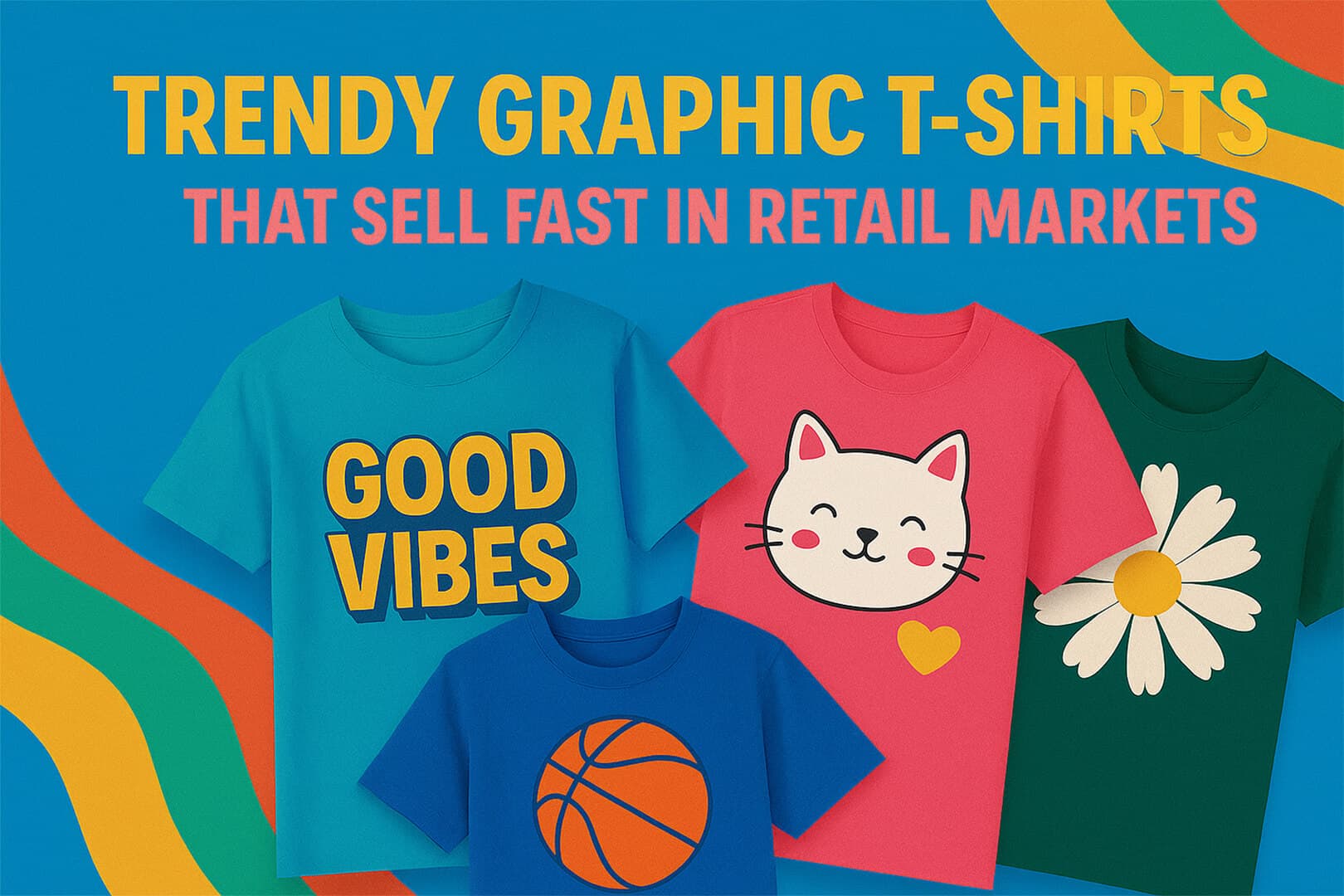
Retail buyers keep coming back to one product category more than almost any other: trendy graphic t-shirts. They sell fast, cost little to produce relative to their retail price, and give a store or an online catalogue an easy way to refresh its look every season without touching the rest of the range.
This guide walks through what actually makes trendy graphic t-shirts sell in retail markets, from design and fabric through printing method and order structure. We also cover how LAMBLILY, a kidswear manufacturer and exporter based in Chennai, builds graphic tees for private label buyers who need consistent quality at a workable minimum order quantity.
Why Trendy Graphic T-Shirts Keep Selling in Retail Markets
Graphic tees hold a unique place in retail because they let a shopper express an identity without committing to an entire outfit change. A parent buying kidswear, or a retailer stocking a children's section, treats trendy graphic t-shirts as a low-risk purchase with high visual return.
- Fast sell-through, since a bold print catches attention on a rack faster than a plain garment.
- Low production cost relative to more structured garments, since a tee needs no lining or complex construction.
- Easy seasonal refresh, since a retailer can rotate designs every few months without changing the base garment.
- Strong repeat purchase behaviour, since children outgrow sizes quickly and parents restock often.
- Wide appeal across age brackets, from toddlers through early teens, within a single core silhouette.
Retailers across the UK, USA, UAE, Canada, and Australia continue to place bulk orders for trendy graphic t-shirts for exactly these reasons. The category rewards a manufacturer who treats design, fabric, and print durability as three connected decisions rather than three separate ones.
What Makes a Graphic Tee Genuinely Trendy
Not every printed t-shirt qualifies as trend-forward. Our team sees three recurring factors that separate trendy graphic t-shirts from tees that sit unsold on a shelf.
- The design responds to a current cultural reference, whether that is pop culture, a nature motif, or a regional theme relevant to the buyer's market.
- The print reads clearly at a glance, since most buyers decide within seconds whether a design appeals to them.
- The garment underneath feels as good as the print looks, since a scratchy or poorly finished tee undercuts even a great design.
Design trends shift constantly, but a few categories remain dependable across seasons for trendy graphic t-shirts aimed at children's retail.
- Minimalist typography with a short, punchy phrase or single word.
- Anime and pop culture references, adapted for a younger audience.
- Motivational slogans, kept short enough to read from a distance.
- Nature and abstract prints, which age well and rarely feel dated.
- Localized or regional themes, which perform strongly in domestic retail markets.
Fabric Choices Behind Trendy Graphic T-Shirts
A striking design cannot save a tee built on the wrong fabric. Buyers sourcing trendy graphic t-shirts should evaluate fabric with the same care they give the artwork itself, since fabric drives comfort, durability, and how well the print eventually holds up.
- 100% organic cotton: breathable and soft against skin, our preferred base for children's graphic tees.
- Cotton-lycra blends: add stretch for active kids without losing the cotton feel.
- Bio-washed or enzyme-treated cotton: delivers a smoother, softer finish straight off the line.
- Ring-spun combed cotton: stronger and smoother than standard carded cotton, holding up better through repeated washing.
Our team recommends a GSM in the 160 to 180 range for most trendy graphic t-shirts, since this balances a substantial hand-feel with breathability for everyday wear. Tighter, even-weave knits also hold printed detail better than loosely woven fabric, which matters directly for print longevity.
Printing Techniques That Keep a Design Looking Sharp
The printing method chosen for trendy graphic t-shirts affects cost, turnaround, and how long the design survives repeated washing. LAMBLILY works with several methods depending on the design, order size, and fabric.
- High-density screen printing: cost-effective for larger orders with a limited number of colors, and holds up well over time.
- DTG (direct-to-garment) printing: suited to detailed, multi-color designs in small to mid-size runs.
- DTF (direct-to-film) printing: works well on cotton and cotton blends, holding fine detail without a large minimum order.
- Puff, foil, and reflective prints: premium finishing options for retail lines that want a design to stand apart on the rack.
- Sublimation printing: best suited to polyester or poly-blend fabric for vibrant, all-over designs that will not crack.
We test every new fabric and printing method combination with a wash cycle before approving it for bulk production, since a print that fades within a handful of washes will not keep trendy graphic t-shirts moving off a retail shelf for long.
How LAMBLILY Builds Trendy Graphic T-Shirts for Retail Buyers
LAMBLILY PRIVATE LIMITED is based in Vandalur, Chennai, Tamil Nadu. It was founded in 2019 by Juliet Preena, a Montessori educator who leads design, and Leo Daniel Raja, who brings over 13 years of supply chain and manufacturing experience. That combination shapes how our team approaches every order for trendy graphic t-shirts, from artwork review through final quality check.
We print on GOTS-certified organic cotton and OEKO-TEX-compliant fabric, and every printed sample goes through a wash test before bulk production starts. Orders ship FOB to the UAE, UK, USA, Canada, and Australia, with a minimum order quantity of 100 pieces per colour and payment handled through 100% advance SWIFT transfer.
- Low MOQ: start from 100 pieces per colour, workable for retailers testing a new design before committing to a larger run.
- Private labeling: tags, woven or printed labels, and retail-ready packaging included.
- Custom print support: upload your own artwork, or work with our team to adapt a trending design for kids sizing.
- Global shipping: FOB terms to the UAE, UK, USA, Canada, and Australia.
- Size range: children's sizing from 0 to 16 years, built around real growth proportions rather than scaled-down adult patterns.
Fabric Specification Reference for Graphic Tees
The table below summarizes fabric options our team commonly recommends for trendy graphic t-shirts, alongside the printing methods that pair best with each.
| Fabric | Typical GSM | Best Printing Method | Notes |
|---|---|---|---|
| 100% organic cotton | 160-180 | Screen print, DTF | Softest hand-feel, GOTS-certified |
| Ring-spun combed cotton | 150-170 | DTG, DTF | Strong, smooth surface for fine detail |
| Cotton-lycra blend | 180-200 | Screen print | Stretch for active play |
| Poly-cotton blend | 160-190 | Sublimation | More wrinkle-resistant, uniform-friendly |
Why Retailers Choose LAMBLILY for Graphic Tee Programs
Retailers evaluating a manufacturer for trendy graphic t-shirts usually ask about consistency across repeat orders, not just the quality of a single sample. Our team keeps a reference file for every approved design, recording exact color codes, fabric batch, and print settings so a reorder six months later still matches the original.
Buyers also ask about certification. We work with GOTS-certified organic cotton and OEKO-TEX Standard 100 compliant fabric, and our sourcing aligns with Better Cotton Initiative benchmarks for responsible cotton farming. These standards matter as much for children's graphic tees as they do for any other kidswear category, since young skin is more sensitive to harsh dyes and finishing chemicals.
Choosing Designs That Perform Across Age Groups
Trendy graphic t-shirts for a children's retail range need to work across a fairly wide age bracket, often 2 to 12 years within a single collection. A design that reads well on a toddler tee can look out of proportion once scaled to a size 12, so our team tests print placement across the intended size range before finalizing a design for bulk production.
- Center chest placement suits most graphic designs and remains the most versatile option.
- Full-front prints work for bold statement designs but need growth room built into the pattern.
- Smaller logo placements on the sleeve or pocket suit understated branding.
- Back-of-garment placement works well for team or event-branded programs.
Common Mistakes Retail Buyers Make When Sourcing Graphic Tees
Even an experienced retail buyer can run into avoidable problems when sourcing trendy graphic t-shirts at scale. Our team sees a handful of issues repeat across new buyer relationships.
- Approving artwork from a low-resolution file, then discovering pixelation once printed at full size.
- Skipping a physical wash-tested sample and approving a design from a digital mockup alone.
- Choosing a printing method that does not suit the fabric, leading to cracking after a few washes.
- Ignoring how a design will look once resized across the full kids sizing range in the order.
- Rushing a reorder without checking the reference file, resulting in a color or fabric mismatch.
Catching these issues before bulk production begins costs far less than fixing them after a shipment has already reached a retail floor.
What Buyers Should Ask Before Placing a Bulk Order
Before committing to a bulk run of trendy graphic t-shirts, our team recommends asking a manufacturer a few direct questions.
- Which printing method do you recommend for this specific design and fabric.
- Can you provide a physical, wash-tested sample before bulk production begins.
- What certification documents do you hold for the fabric being used.
- What is the minimum order quantity, and does it apply per colour or per design.
- How do you keep color and fabric consistent across a second or third reorder.
A manufacturer who answers with documentation and samples, rather than reassurances alone, is usually the safer long-term partner for a retail graphic tee program.
How Search Intent Shapes This Category
Buyers researching trendy graphic t-shirts usually fall into a few groups, and understanding the split helps explain why our approach differs by buyer type.
- Retail buyers comparing manufacturers for a store or online catalogue restock.
- Private label brands looking for a design and print partner for a new collection.
- Parents and small resellers sourcing smaller test batches before committing to volume.
- Sourcing agents comparing fabric and certification standards across several factories.
Whichever group a buyer falls into, the same underlying questions about fabric, certification, and print durability apply before any bulk order for trendy graphic t-shirts should move forward.
Seasonal Planning for a Graphic Tee Program
Retailers who plan graphic tee drops around a seasonal calendar tend to see stronger sell-through than those who order reactively. Our team recommends locking artwork at least eight weeks ahead of a planned retail launch, which allows time for sampling, a wash test, and bulk production without rushing any step.
A typical timeline for trendy graphic t-shirts runs from artwork approval, through a physical sample and wash test, into bulk cutting and printing, and finally quality checking before shipment. Building this buffer into a seasonal plan avoids the quality shortcuts that rushed reorders tend to introduce.
Quality Checks Applied to Every Graphic Tee Order
Every batch of trendy graphic t-shirts produced at LAMBLILY goes through fabric verification before cutting begins, confirming GSM, composition, and certification match the approved specification sheet. Stitching is checked along the neckline and side seams, since these areas see the most stress during wear and washing.
Print samples are verified against the approved artwork and color reference before bulk printing starts, and a random sample from each production lot goes through a wash test to confirm shrinkage and colorfastness stay within the agreed range. This process applies the same standard described in our broader guide on fabric for export t-shirts.
How This Connects to Fabric, Sizing, and Printing Decisions
Sourcing trendy graphic t-shirts rarely comes down to design alone. Fabric choice, sizing accuracy, and printing method all interact, which is why our guide on choosing the right size for kids is worth reading alongside this one. For a deeper look at printing methods and placement, see the art of custom printing.
Buyers building a broader kidswear catalogue often also review our complete fabric knowledge base and our fabric quality evaluation guide. Our round neck t-shirt guide also covers the base silhouette most graphic tees are built on.

Key Takeaways
- Trendy graphic t-shirts sell well in retail because they offer fast, low-risk seasonal refresh.
- Fabric choice and printing method should be decided together, not separately.
- GSM in the 160 to 180 range suits most children's graphic tees.
- Placement and sizing should be tested across the full age range in an order, not one sample size.
- A wash-tested physical sample protects a bulk order before it reaches a retail floor.

A Final Word on Consistency for Retail Buyers
The single biggest factor in whether a retail buyer keeps reordering trendy graphic t-shirts from the same manufacturer is consistency across batches. A print that looks perfect in one shipment but slightly off in the next erodes buyer trust quickly, even if each individual tee looks fine on its own.
Our team keeps a master reference file for every approved design, including exact color codes, fabric batch, and printing settings, checked against every new production run whether it is the second batch or the twentieth. Consistency, more than any single clever design, is what keeps a retail buyer returning to the same manufacturer season after season.
Frequently Asked Questions
Fast sell-through, low production cost, and easy seasonal refresh make graphic tees a dependable category for retailers. A bold, current design paired with a comfortable fabric tends to outperform plain garments on turnover.
Conclusion
Sourcing trendy graphic t-shirts that actually sell in retail markets comes down to a handful of consistent decisions: a design that reads clearly, a fabric that feels as good as the print looks, and a printing method matched correctly to both. Consistency across repeat orders matters just as much as the first sample.
Our team at LAMBLILY builds graphic tees around exactly these principles, using GOTS-certified organic cotton and OEKO-TEX-compliant fabric with a minimum order quantity of 100 pieces per colour. If you are sourcing a graphic tee program for a retail collection, contact us on WhatsApp or email us. You can also browse our current collection in the shop or learn more about our production process on the manufacturing page.
Sources & References
Fabric and certification standards referenced in this guide draw on OEKO-TEX and the Global Organic Textile Standard. Cotton sourcing practices align with Better Cotton Initiative benchmarks for responsible farming.